



|

Picture Logic puzzlesNumber Logic puzzles
|
Sudoku techniquesWhile easy Sudoku puzzles may be solved by intuition, harder levels require advanced logic and substantial practice to deduct which clue can be placed in a square, and moreover, which clue cannot. This guide covers a full range of strategies, from fundamental row and column scanning to advanced analyzing techniques for the most complex puzzles, helping you improve your skills in Classic Sudoku and Killer Sudoku. You can also practice and learn more about these techniques by using the Assistant feature, which is embedded in our apps and desktop games on the following platforms:
IntroductionSudoku grid consists of 81 squares divided into nine columns marked a through i, and nine rows marked 1 through 9. The grid is also divided into nine 3x3 sub-grids named boxes which are marked box 1 through box 9. 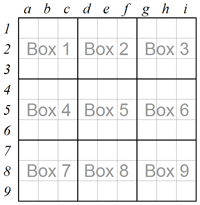
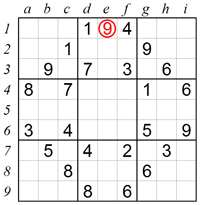
Scanning techniquesThe easiest way starting a Sudoku puzzle is to scan rows and columns within each triple-box area, eliminating numbers or squares and finding situations where only a single number can fit into a single square. The scanning technique is fast and usually sufficient to solve easy puzzles all the way to the end. The scanning technique is also very useful for hard puzzles up to the point where no further progress can be made and more advanced solving techniques are required. Here are some ways of using scanning techniques: 1. Scanning in one direction:In our first example we will focus on box 2, which like any other box in Sudoku must contain 9. Looking at box 1 and box 3 we can see there are already 9s in row 2 and in row 3, which excludes the two bottom rows of box 2 from having 9. This leaves square e1 as the only possible place into which 9 can fit in. 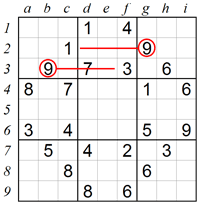
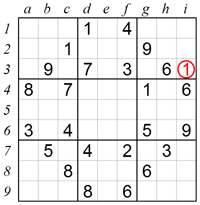
2. Scanning in two directions:The same technique can be expanded by using information from perpendicular rows and columns. Let’s see where we can place 1 in box 3. In this example, row 1 and row 2 contain 1s, which leaves two empty squares in the bottom of box 3. However, square g4 also contains 1, so no additional 1 is allowed in column g. This means that square i3 is the only place left for 1. 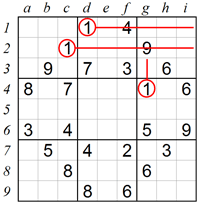
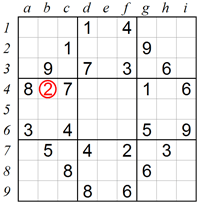
3. Searching for Single Candidates:Often only one number can be in a square because the remaining eight are already used in the relevant row, column and box. Taking a careful look at square b4 we can see that 3, 4, 7 and 8 are already used in the same box, 1 and 6 are used in the same row, and 5 and 9 are used in the same column. Eliminating all the above numbers leaves 2 as the single candidate for square b4. 
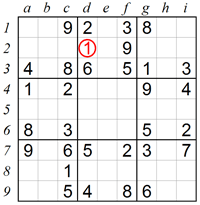
4. Eliminating numbers from rows, columns and boxes:There are more complex ways to find numbers by using the process of elimination. In this example the 1 in square c8 implies that either square e7 or square e9 must contain 1. Whichever the case may be, the 1 of column e is in box 8 and it is therefore not possible to have 1 in the centre column of box 2. So the only square left for 1 in box 2 is square d2. 
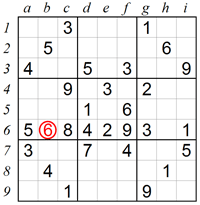
5. Searching for missing numbers in rows and columns:This method can be particularly useful when rows (and columns) are close to completion. Let’s take a look at row 6. Seven of the nine squares contain the numbers 1, 2, 3, 4, 5, 8 and 9, which means that 6 and 7 are missing. However, 6 cannot be in square h6 because there is already 6 in that column. Therefore the 6 must be in square b6. 
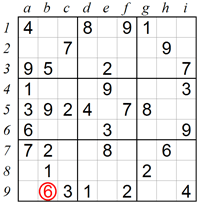
Analyzing techniquesAs Sudoku puzzle levels get harder you will find the simple scanning methods described above are not enough and more sophisticated solving techniques must be used. Hard puzzles require deeper logic analysis which is done with the aid of pencilmarks. Sudoku pencilmarking is a systematic process writing small numbers inside the squares to denote which ones may fit in. After pencilmarking the puzzle, the solver must analyze the results, identify special number combinations and deduce which numbers should be placed where. Here are some ways of using analyzing techniques: 1. Eliminating squares using Naked Pairs in a box:In this example, squares c7 and c8 in box 7 can only contain 4 and 9 as shown with the red pencilmarks below. We don’t know which is which, but we do know that both squares are occupied. In addition, square a6 excludes 6 from being in the left column of box 7. As a result the 6 can only be in square b9. Such cases where the same pair can only be placed in two boxes is called Disjoint Subsets, and if the Disjoint Subsets are easy to see then they are called Naked Pairs. 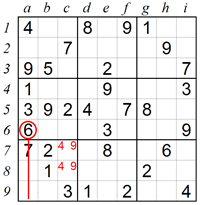
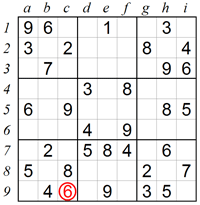
2. Eliminating squares using Naked Pairs in rows and columns:The previous solving technique is useful for deducing a number within a row or column instead of a box. In this example we see that squares d9 and f9 in box 8 can only contain 2 and 7. Again we don’t know which is which, but we do know that both squares are occupied. The numbers which remain to be placed in row 9 are 1, 6 and 8. However, 6 can’t be placed in square a9 or in square i9, so the only possible place is square c9. 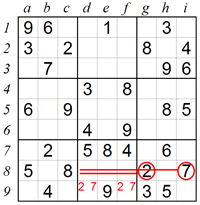
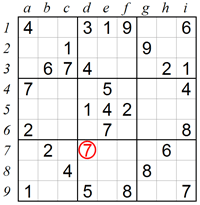
3. Eliminating squares using Hidden Pairs in rows and columns:Disjoint Subsets are not always obvious to see at first sight, in which case they are called Hidden Pairs. If we take a very close look at the pencilmarks in row 7 we can see that both 1 and 4 can only be in square f7 and square g7. This means that 1 and 4 are a Hidden Pair, and that square f7 and square g7 cannot contain any other number. Using the scanning technique we see that 7 can only be in square d7. 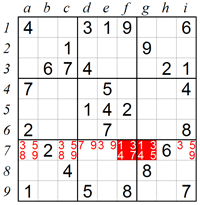
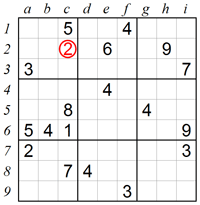
4. Eliminating squares using X-Wing:The X-Wing technique is used in rare situations which occur in some extremely difficult puzzles. Scanning column a we see that 4 can only be in square a2 or square a9. Similarly, 4 can only be in square i2 or square i9. Because of the X-Wing pattern where boxes are in the same row (or column), a new logic constraint occurs: it is obvious that in row 2 the 4 can only be either in square a2 or in square i2, and it cannot be in any other square. Therefore 4 is excluded from square c2, and square c2 must be 2. 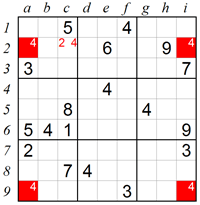
Killer Sudoku techniquesKiller Sudoku grids, also known as Sum Sudoku, consist of 81 squares divided into nine columns marked a through i, and nine rows marked 1 through 9. The grid is also divided into nine 3x3 sub-grids named boxes which are marked box 1 through box 9, as well as sum-areas which are surrounded with a gray or dotted line. Killer Sudoku are solved using the Classic Sudoku methods, as well as several additional techniques which are unique for these wonderful puzzles. 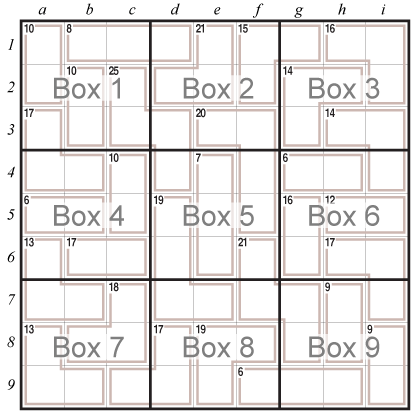
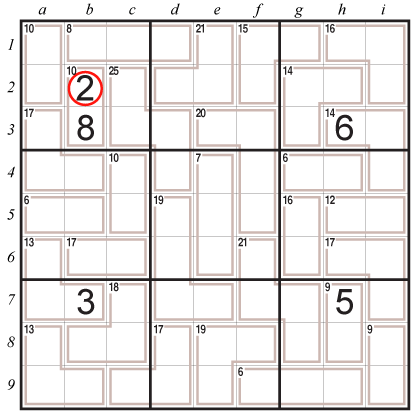
1. Last DigitIn some cases, using the Last Digit technique is the easiest way to start solving a Killer Sudoku puzzle. The sum-area in the puzzle below, highlighted in yellow, contains two squares which together add up to 10. Since one of the squares contains 8, the empty square b2 must be 10-8=2. 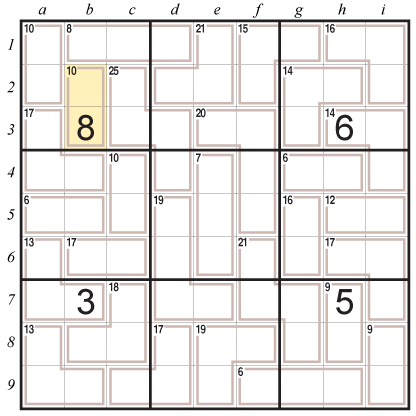
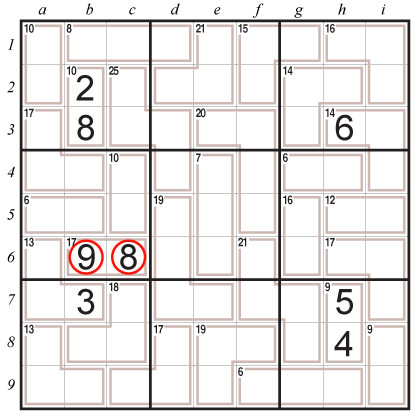
2. Naked SingleLet’s look at the sum-area of 17 highlighted below. There are two squares in this area which add up to 17, so the numbers they contain can only be 8+9 or 9+8 as shown with the red pencilmarks. However, since column b already contains 8, square b6 must be 9 and square c6 must be 8. 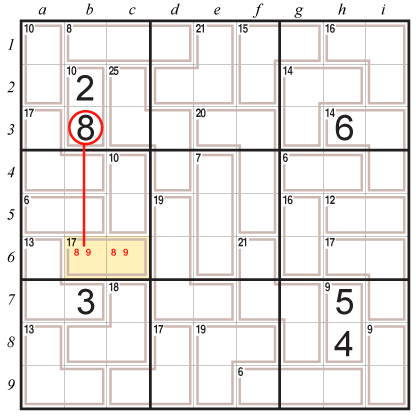
3. Hidden SingleThe Hidden Single technique starts showing us the true greatness of Killer Sudoku puzzles. Let’s focus on Box 6 in the puzzle below, and try to find out in which square we can place 6. It is obvious that 6 cannot be placed in squares h4, h5 and h6 because column h already contains 6. In addition, 6 cannot be placed in any of the highlighted squares for the following reasons: The yellow sum-area already contains 6, the green sum-area cannot contain 6 because 6+0 is not allowed, and the blue sum-area cannot contain 6 because of the special Killer Sudoku rule that no number may be used in the same sum-area more than once. This leaves square i6 as the only candidate where 6 can be placed. 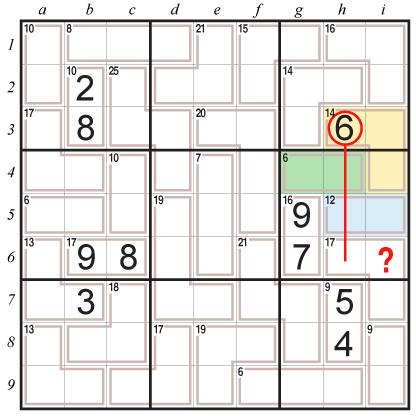
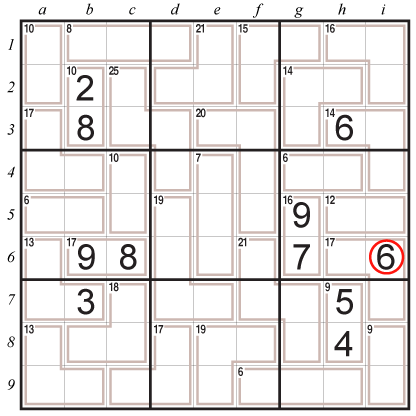
4. Scanning in one directionUnlike Classic Sudoku, where scanning techniques are usually used right from the beginning, in Killer Sudoku these techniques usually come up after several squares have been filled in. In the puzzle below we see that 4 and 8 are still missing in box 6. However, we cannot place 4 in square h5 because column h already contains 4 so the only square where 4 can be placed is i5. 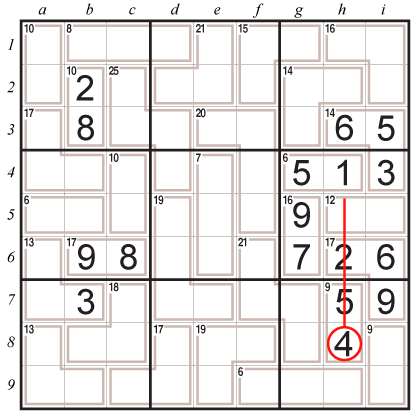
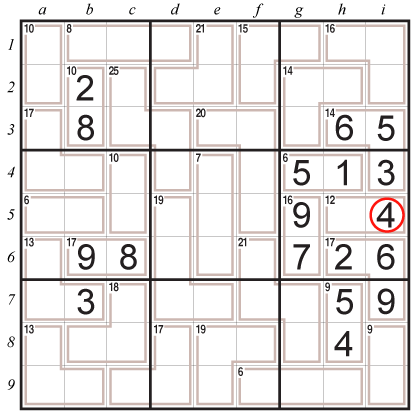
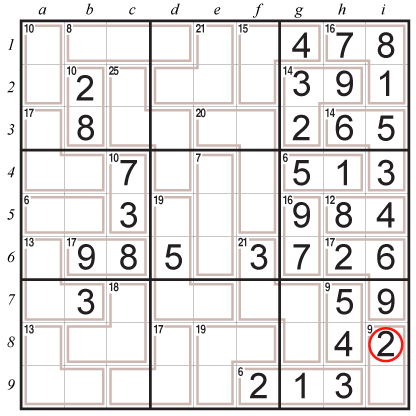
5. Scanning in two directionsSimilar to the example above, column g and row 9 already contain 2. This means that the only square in column i in which we can place 2 is i8. 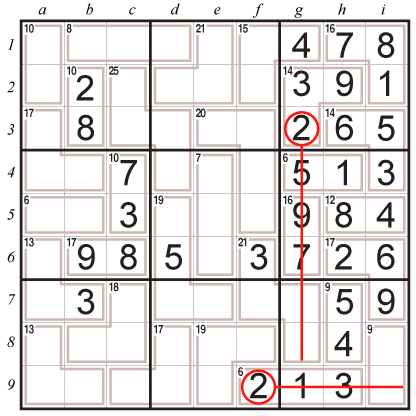
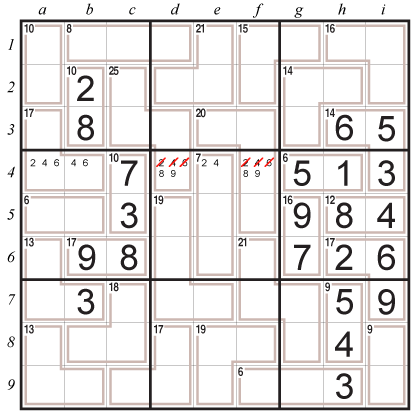
6. Hidden PairsKiller Sudoku puzzles require the extensive use of pencilmarks, so the key is learning more techniques how to identify and remove those pencilmarks which are not needed. In the example below is a puzzle showing all the valid pencilmarks in line 4 at this stage of the solution. The pencilmarks are shown only for line 4 to minimize obstruction of the picture. Looking at row 4 we see that the only squares which can contain 8 and 9 are d4 and f4, which means they cannot contain any other number and therefore the pencilmarks 2, 4 and 6 must be removed. 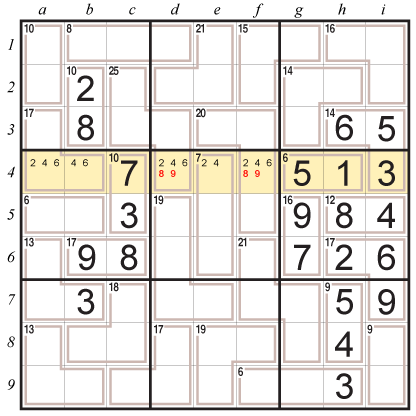
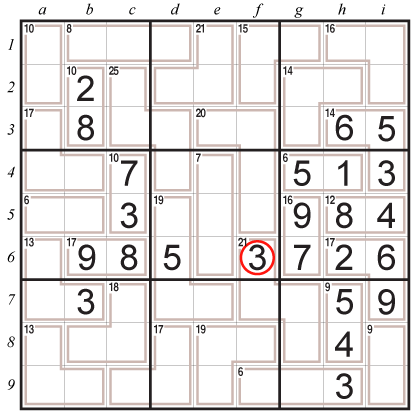
7. Naked PairsIn row 6 three numbers are still missing: 1, 3, and 4. If we further examine the squares, we see that square a6 can be either 1 or 4 (because 3 is already used in the yellow sum-area), and square e6 can also be either 1 or 4 (because the green sum-area can only be 1+2+4). This leaves square f6 with the only candidate of 3. 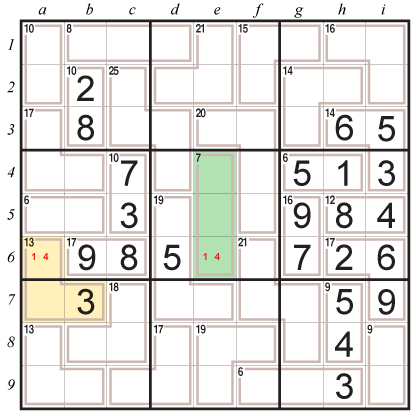
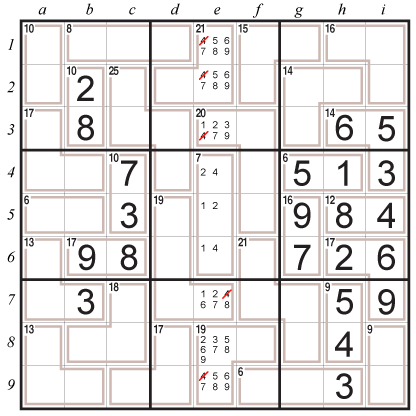
8. Pointing PairsAnother very common technique to remove pencilmarks in Killer Sudoku puzzles is Pointing Pairs. In the partially solved puzzle below, column e fully contains a sum-area of 7 which, according to the rules of Killer Sudoku, can only sum up with the numbers 1+2+4. This means that all remaining squares in column e cannot contain 4 and the pencilmark 4 must be removed from all squares except e8. 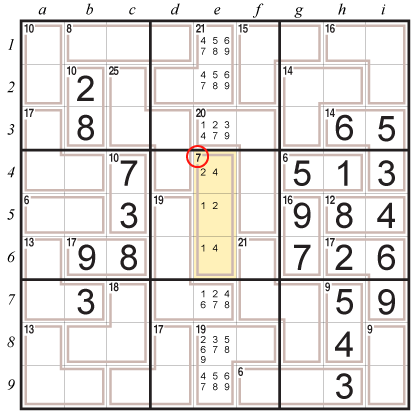
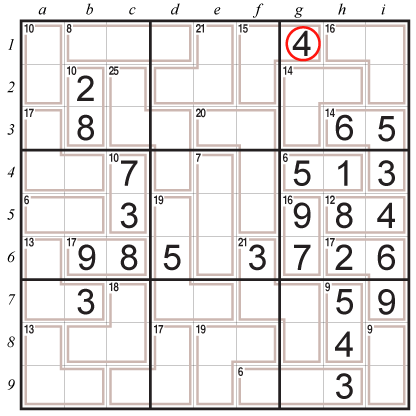
9. Innies and Outies (boxes)The Innies and Outies technique is based on the special case where the sum of all nine squares in a box is always 45. Let’s look at box 3 in the puzzle below, which contains nine squares. The sum of the three green squares is 16, the sum of the three yellow squares is 14, the number in the blue square is 6 and the number in the pink square is 5. So, if we add up all squares except g1 we get 16+14+6+5=41. This means that the empty square g1 must be 45-41=4. 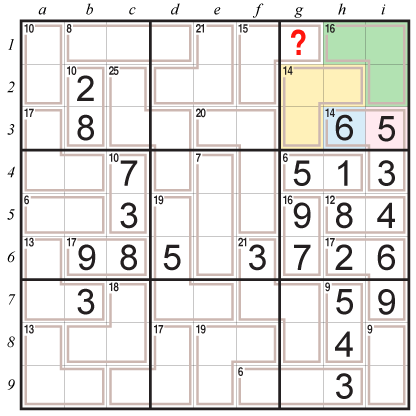
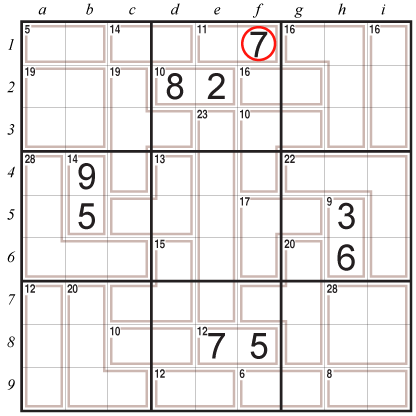
10. Innies and Outies (rows/columns)The Innies and Outies technique can be used for rows and columns as well, since every row and every column must also sum up to 45. Let’s look at the four yellow columns f, g, h and i in the puzzle below. If we add up all the sum-area clues in these columns we get 16+16+16+10+22+17+9+20+28+6+8=168. In addition, we have 5 in square f8, which is part of the four columns and which we need to bring into account as well. This brings up the total sum of all squares in yellow to 168+5=173. Since the 4 yellow columns must add up to 180, the last remaining empty square f1 must be 180-173=7. 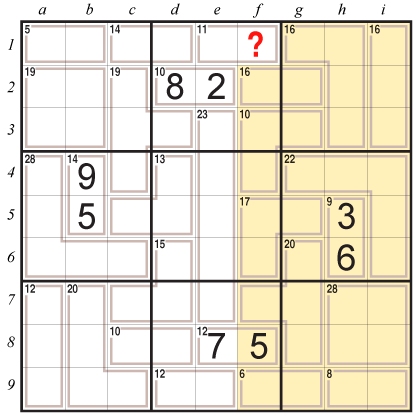
|


